Sunday, June 28, 2009

How Do I Licsence A Trailer

LED lighting for aquariums

Alpheus designs and develops LED lighting for aquariums with high performance.

The equipment offered for reef aquariums use secure technologies and energy saving. This respect for the environment is of course by that of animals placed in the aquarium. For this reason, the technical choices are made above all other considerations, to obtain the best results to ensure the conservation and propagation of species dependent on photosynthesis. Tests conducted since 2006 on our reef systems to verify by experiment the validity of our options.

Personal safety, dependability, availability of equipment and also the visual amenity are not overlooked and are important points of this approach.

Personalized service
Because each aquarium is unique, Alpheus develops a range of facilities perfectly adapted to the dimensions of your aquarium. You define your exact needs, you may be guided by the contact form online. The specific requirements are considered and we validate a joint solution. So you have the satisfaction of achievement to measure consistent your goal. The components of the standard equipment, however, limiting manufacturing costs. Ask us to quote the price of these modular devices is equivalent to complete the proposed ramps in series. This design adds other benefits compared to a ramp monolithic, as, for example, removing a module for an overhaul while maintaining the operational ramp or a reorganization to adapt to a new aquarium.

Products can be delivered at various stages of completion or kit, consisting of simple modules wired and tested ready to be embedded in a carrier. For the more skilled it is an economy and also a custom finish. In all cases, Alpheus, a specialist in reef aquariums, advises and supports you in choosing and maintaining your aquarium.

Direct access to the store
LED Lighting Direct access to the store Automation (under development, please contact us for quotation)


LEDs: a solution for lighting aquarium eco-friendly '
The position as "an energy "Of the reef aquarium is undoubtedly the canopy. The light intensity must indeed satisfy the needs of photosynthetic organisms, including corals symbiotic algae zooxanthellae. To perform this vital function, illumination reproduces the natural environment of the tropics. This implies an illumination intensity in a high color temperature. One of the best conversion efficiencies of light, approximately 100 lumens per watt, is achieved through components LED (Light Emitting Diode) - or LED (acronym for Light Emitting Diode). It is therefore natural to make ramps based on this technology. We proceed to development since 2006 and test prototypes on our reef aquariums illuminated only by ramps with LEDs. The result of these tests demonstrate compatibility with the physiology of reef organisms. The energy gain obtained compared to traditional solutions is close to a ratio of two. This result is also a consequence of the high directionality of LEDs that greatly reduces the losses by scattering or reflection. The illumination is evenly distributed areas without too many or too few choices. Thus, an aquarium where a ramp 400 Watt HQI was necessary may be illuminated by LEDs with only 200 watts power. Energy useful light for photosynthesis will be equivalent. However this figure is not a constant of all LED lighting, the selection of components, their implementation must be done within the rules of art and with attention to an excellent result. See this topic headings: LED technology and Solar radiation and photosynthesis
The choice of LED lighting should not be done on the simple observation of a favorable energy balance. Other criteria to consider to ensure that lighting is able to perform its function and give full satisfaction.
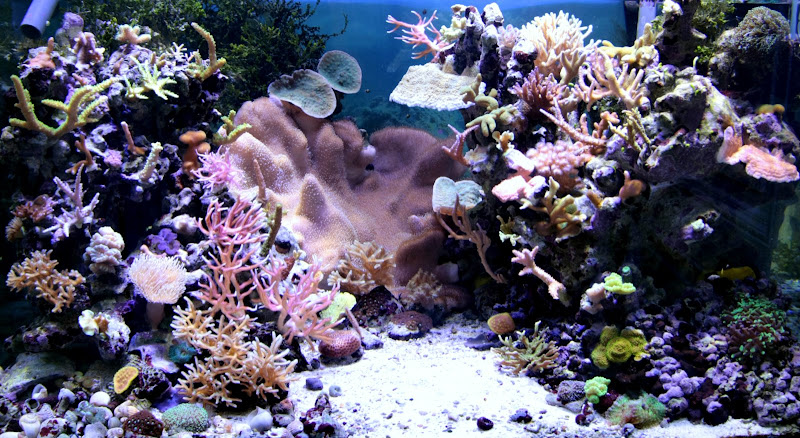
Aquarium Test lit solely by LEDs
tracking the evolution of many cuttings SPS and Tridacna (giant clam)

Energy, light spectrum and photosynthesis
While the measure lumens is a good indication of the illumination seen by our vision, light energy for photosynthesis is preferably measured with a PAR meter. PAR stands for Photosynthetically Active Radiation. The PAR is the unit mol / m / s which corresponds to a radiometric energy. Indeed, vision and photosynthesis differ on matters it is interesting to know to properly understand the lighting of an aquarium.

An approach to determine the light intensity necessary for an aquarium is to replicate the quality and quantity of light energy received in one day in a natural environment and at a given depth. The energy received at the surface on a sunny day for a tropical area is 50mol / m². Note that most of the energy is supplied during the 6 hours that the sun is highest in the sky (we used this term of reference to determine the photoperiod useful). Reflection due mitigates the impact strongly inclined rays of dawn and dusk. In the aquarium this value should be lower because it takes into account the attenuation due to the depth of water corresponding middle reproduced and also lengthening the duration of the illumination of the aquarium to satisfy the viewer. Again, the LEDs are also an excellent solution to calibrate the color temperature, intensity and duration of illumination depending on the biotope and recreated on the requirements of the aquarium.

curve of intensity and chromatic reduction (Source Educnet) versus water depth

water filter solar radiation and solar spectrum is reduced quickly to initial wavelengths from green to UV-A long close to the visible. The colors red, hot, characteristics of dawn and dusk, are masked by the impact and reflection of rays, so too strongly inclined to enter the aquatic environment. The color temperatures are, for a marine aquarium in the range 20 000-10 000 K (Kelvin).

Regarding the photo-period, there is still respect the natural conditions, a bright light over a period relatively short, approximately 6 hours. Subdued lighting can be extended as actually present in the natural environment and also benefit from a longer observation period. The dimming is therefore a major asset. A series of photo-adaptation of animals and plants may also be necessary before the high energy delivered by the LED lighting Alpheus. The creation of 'breaks' during the phase of maximum illumination to optimize the cycle of photosynthesis and avoid the risk of photo-inhibition. These breaks can be made by the simulation of cloudy and are also naturally present through alternations to light due to surface movement.

addition biotope, population photosynthetic parameters affecting the irradiance as water clarity (turbidity) of the aquarium, the use of charcoal, possibly ozone enhances transparency, the presence a white background that reflects light, are quantitative and qualitative elements that must be integrated to define the ramp LED light ideal for your use reef.

In summary, according to the choice of the aquarium, it takes between 50 and 300 mol / m / s to maintain properly invertebrates symbiotic in aquariums. A color temperature of 14000K is an average basis which can be further increased.
Readers wishing to explore this subject refer to the work of Stéphane Fournier " lighting aquariums " published Animalia.

Dimming light
The possibility of a change in the intensity of lighting is an excellent solution for metering energy, respect and physiological cycles also bring an additional authorization in the contemplation of his aquarium. LED technology is "dimmable", which means it is possible to decrease or increase Gradually the light intensity. Alpheus with the ramps, LEDs of different color temperatures are independently Assayable not change too small (the encoding is 16 bits, or variations of 0.03%). For the aquarist is the visual amenity of sunrise and sunset, the possibility of adjusting its light very precisely according to its habitat and the opportunity to showcase the coral fluorescence visible under bright deep blue. For organizations of the aquarium, the reproduction of natural solar and lunar cycles provides significant physiological benefit. Solar time, the simulation of cloudy, colorimetry, all parameters are recreating the natural environment under the control of a controller built into the ramp. This is configured in the factory, it is also adjustable and controllable by the user using a PC with a Bluetooth connection. A program for Windows comes with the controller (and the key for PC Bluetooth communication). Menus provide access to parameters defining the different cycles, or switch to manual mode where control is direct. The controller also adds elements of comfort as the cumulative hours of operation of the ramp or the fan control air conditioning if intégré.Voir detail in Shop Lighting LED

In the case of replacing a traditional ramp by ramp Alpheus, the old ramp will be measured or assessed before its removal to determine its BY intensity. An automatic, specific ramps Alpheus, gradually increase this value to achieve the optimal flow while eliminating the risk of photo-inhibition. The animals are not stressed by an abrupt difference in light intensity.

Elevation reduced thermal
The LED illumination does not cause virtually no elevation heat which significantly reduces the need for an air conditioning during periods of heat. Avoid this system, which is particularly energy intensive, is good news for enthusiasts concerned about the future of the planet. An air conditioner based on mere fans help evaporate the water surface is usually sufficient with a LED bargraph. The fans can be integration into the ramp and steering from the automatic lighting control.

Quality Guarantee
Components LEDs have a lifetime of remarkable 50,000 hours, which corresponds not to a failure, but a reduction of 30% of initial lumens. This figure is however valid only if they meet the design rules imposed by the manufacturers of LEDs and a poorly designed ramp will not reach this time. Alpheus applies to reaching a long period of use without loss of performance and commitment over a three year warranty for all its products. Each ramp comes with a certificate stating the extent BY done after development, that is to say its optimum efficiency to serve as future reference. It is only those circumstances that the LED lamps make substantial savings compared repeated changes at best annually, tubes fluorescents or metal halide. It also means less waste to recycle. However, failures are possible and replacing faulty LED should not be an insoluble problem. But these components are not removable simpleùent. To overcome this drawback Alpheus ramps are designed modular. The modules are easily removable and can be repaired without disturbing the overall operation of the ramp.
For more information see: The LED technology has

Placement
Les rampes alpheus sont équipées de lentilles secondaires. Celles-ci sont indispensables car les LED de puissance ne focalisent pas la lumière (ouverture de 90 à 125° selon les modèles) et des pertes peuvent survenir. Les lentilles concentrent la lumière dans un cône utile de 10 à 40° selon les modèles. Ces lentilles regroupent trois LED et sont constituées de micro diffuseurs de sorte à ce que le mélange chromatique soit parfait (pas de distinction possible des zones bleues ou blanches). Grâce à l'utilisation de lentilles de focalisation, les rampes alpheus peuvent être suspendues jusqu'à 50 cm de la surface de l'eau ce qui minimise les pertes optiques. L'éloignement de The ramp also allows the light sources away from splashing water, the source of corrosion and fouling. Access to the aquarium from above remains free and the general appearance of more open and natural. Unlike fluorescent tubes, the effect of shimmering light on the sand and the scenery is very realistic. This natural effect is not just aesthetic, it also brings a benefit to animals zooxanthellae significantly enhancing the efficiency of photosynthesis.

dimming light output by 4 meters in natural

Safeties
LED lighting also has an advantage: risk reduction electrical, thermal and optical. The power circuit is made of LED, Low Voltage Safety '(SELV), that is to say a voltage below 30 VDC and isolated area. In this case a default installation does not present a risk of electrocution as is the case for a ramp driven at 220 volts. This is important for a facility located in humid and saline. On the other hand, the low operating temperature eliminates any risk of burns from accidental contact. The choice of generously sized heatsinks overcomes the fans source of failure and noise. Finally, the spectral stability eliminates ultraviolet radiation harmful to living cells.


Summary of key points of the ramps Alpheus
  1. A Tough choices of the best components available, the full mastery of the development and manufacturing. A
  2. adequacy verified with the needs of photosynthetic organisms reef aquariums.
  3. An adaptive modular design that allows, for example, repairing a simple mail without a complete cessation of the ramp.
  4. A heat dissipation by natural convection largely dimensioned to prevent the use of fans (silence and reliability).
  5. A comprehensive management controller and optional upgradeable to minimize the initial cost.
  6. An investment in height that allows unobstructed surface of the aquarium.
  7. warranted for three years and a permanent availability for the assurance of a return on investment.

Without omitting the benefits inherent in LED technology: Reduction of energy consumption, long lifespan, low heat release into the aquarium, all gradations possible, ...


A video of the aquarium in which the effect is visible light vibration


switchboards and automation
Alpheus protects the environment but is also concerned with people. Switchboards having differential protection, earth sensors and automation are offered.
As for lighting tracks, achievements are made on customer specifications for a perfect result adapted as needed.

For more information look under Automation.

Smuckers Peanut Butter Coupon

LED technology

In our reef aquariums, LEDs (Light Emitting Diode), or the French 'DEL' (Light Emitting Diode), are they a credible alternative to conventional solutions based on the T5 fluorescent tubes and lamps HQI? Here are some answers.

power type LED CREE XR-E

The new generation of power LEDs meet the needs of the signaling car or public, domestic lighting, from backlight screens LCD, camera flashes, etc.. This market is driven by new technologies and the need to reduce energy costs for lighting systems. The desire to make them more 'green' by prohibiting the use of toxic compounds to the environment wins too slowly on the ground.

The advantages put forward by the manufacturers of LEDs are:
  • a very good reliability (degradation does not exceed 70% of initial performance with less than 5% down after 50,000 hours of use (10 years). This life is very much superior to other solutions applicable Market aquarist)
  • a compact miniature
  • low voltage (electrical safety),
  • no inertia when switching on or off (the response time of few nanoseconds allows graduation cutting the ignition timing or PWM),
  • respect for the environment (the LED must comply with new requirements RoHS [Restriction of certain Hazardous Substances] applicable in the EEC),
  • a good choice of colors,
  • yield equivalent and often superior to that of conventional lamps (incandescent, halogen, fluorescent, metal halide, etc.).. LEDs for power, meanwhile, have one of the best power conversion efficiency - light intensity.
Aquarists there are other points of interest, particularly for reef aquariums:
  • light spectrum LED in cool white (or 'cool white') is at a temperature of 6500 Kelvin. This color temperature is consistent with the need reef and photosynthetic activity. FC Solar radiation and photosynthesis . The LED 'cool white' are the easiest to produce because they require less intake of phosphorus than the LEDs 'white hot', ideal for domestic lighting, they are a bit cheaper and have better performance especially.
  • the blue and royal blue LEDs advantageously replace the tubes and super actinic actinic and do not emit UV. The wavelength is always characteristic of a type of LED, for example 455 nm for the 'Royal Blue') and it is perfect for aquarium use because effective for photosynthesis.
  • light intensity available is currently about 100 to 140 lumens per watt LED, which is excellent and an LED can operate a power of 3 Watts. It is now possible to achieve ramps consist exclusively of LED lighting. The number is simply calculated to correspond perfectly to the volume and need.
  • thermal radiation in the direction of the tank is minimal or nonexistent.
The feasibility of a 'spot LED', specifically designed for reef aquarium, is indeed possible. But before buying a spot it is best to understand "how it works' points of detail that makes the difference, because all the LED systems are not equivalent, and whether the expected performance are consistent with the need .


Features LED power
This article takes the example of the LED CREE XR-E XLAMP, the equivalent power LED: Luxeon Rebel, Seoul P4, Edison, Samsung, Nichia, Osram, etc.. could also be used for this demonstration. These LED power of 3 to 5 Watts whose yield is between 100 and 140 lumens / Watt and should not be confused with the conventional LED (without sole sink) and whose performance is lower.

You can find the complete documentation of the LED XR-E site CREE ® ™ XLAMP .

The graph below (source: Lumileds Luxeon) indicates that the performance of LEDs are improving generation after generation. Hopefully prices currently very high, will fall when the LEDs will be widely used for lighting. However, there is no certainty because the technology can change very significantly.
The principle of implementation
intensity produced by an LED CREE XR-E R2 group is about 120 lumens. This is modest when compared to 9000 lumens with a 150W HQI lamp. But this intensity is obtained by passing a current of 350 mA, or about 1 watt of electrical power in an LED. The yield of lumens / Watt LED is better than the HQI (60 lumens / Watt).
Supply current of LED can be increased up to 1000 mA. The yield curve tends to bend, however, meaning that the light output at 700 mA is less than twice that at 350 mA (175%). We see that the current also has the disadvantage of heating the LED and in practice the maximum current of 1000mA that is rarely exploited. Alpheus uses a supply current of 700 mA to optimize the ratio of light intensity / cost. The LEDs used are CREE XR-E R2 groups for white 6500 K, which provides 200 lumens typical LED under 700 mA, and 16 for the blue group Royal. These are the most efficient LED range CREE XR-E.
curve of light output depending on the intensity

All diodes are characterized by a voltage that corresponds to the voltage threshold from which the diode becomes conductive. This voltage is usually denoted VF [Forward Voltage] , it characterizes all the diodes and thus the LEDs.
The curve indicates a voltage of 3.3 volts when forward current IF is 350 mA and 3.7 V at 1A. That means a minimum voltage of 3.5 volts for an LED CREE XR-E work. This also means that the diode will dissipate a power equal to the formula P = IU, or about 3.5 times the current value. This supports a range of diode current of about 1A and are classified for Watts '3 '.

Currently the best power LEDs emit a light intensity greater than 120 lumens per watt . This result is good, this terrain LEDs exceed T5 and HQI are at par with the best fluorescent lamps and high efficiency sulfur plasma lamps.

Features bright

The spectrum of the white LED 'cool white', the blue curve of the diagram, is given to 6500K. In reality the emission is composed of two peaks:
  • the first is close enough to 455 nm (blue - purple)
  • the second largest is 550 nm (green - orange)
The value of 6500K is a rendering method that does not really characterize the spectrum. Here blue is favored with a wavelength very interesting for our reefs. This wavelength naturally favors the growth of zooxanthellae invertebrates. The second peak gives addition color rendering final 'white' and natural light. It also promotes photosynthesis and allows the observation of different colors of marine organisms by improving the CRI (Colour Rendering Index). Note that this spectrum is more complete than most of those obtained with metal halide lamps. On the other hand it is perfectly controlled and characterized.
In the rest of the line XR-E two other references we are particularly interested: The 'Royal Blue' which corresponds to the peak at 455 nm of the white LED, (whose manufacture is actually based on this model), and the 'Blue' with a wavelength of 470 nm.
To promote the wavelength of 450 nm, which reproduces a deep-seated position, it is customary to add blue tubes 'supra actinic' facilities HQI. Further that this temperature has an undeniable aesthetic appeal, this reinforces the useful spectrum for photosynthesis and provides light transitions. Blue light excites the low natural fluorescence of some corals and allows its observation. LED lighting generally uses the colors 'blue' or 'royal blue' in addition to enhancing the color temperature of white LEDs, cool white.'' The color temperature obtained by this combination varies from 6500 to 20000 Kelvin function of the ratio white / blue and setting 'dimming' of the two channels.

LEDs are calibrated spectrum that differs very little from the nominal specifications. LED (white or blue) do not produce UV. This has the advantage not to risk exposing organisms to radiation and too hard to overcome a filter reducing the light flux which is necessary with 20,000 K HQI The power LED are in accordance with IEC 825 safety on emission of light sources. Intensity point however is that it is better not to try watch them directly without protection.

The table below is specific to each manufacturer. It indicates the luminous intensity of LEDs and their color according to a further sorting called 'binning'. The 'binning' is an important checkpoint to select LEDs according to their performance and chromaticism. This is a specialist business and Alpheus selects the best components for use reef. Also note that a white LED to yield 'lumens' four times while a blue LED useful energy for photosynthesis is almost identical. FC Solar radiation and photosynthesis .
Summary wavelengths min / max LED CREE and flow according to the 'binning'

The spectral features are thus identical or above the HQI lamps with only a few compounds spectra of narrow lines. The result is comparable to T5 when additional tubes are combined within a single ramp, taking care to analyze the spectrum of each tube. In Indeed the information is rarely sufficient and lack of action with a PAR meter looks not sufficient to judge the quality of lighting. The problem of the choice of metal halide lamps and T5 arises repeatedly in each bulb replacement LED technology while with the original properties are retained for many years without adverse changes in the animal environment zooxanthellae.

Should add red LEDs to promote photosynthesis? Certainly for terrestrial plants and aquarium plants freshwater developing near the surface. This is less obvious in the case of marine organisms. The penetration of red radiation is strongly attenuated with the water layer and does longer a vital need beyond a few meters. FC LEDs light the Eco-friendly ' . For biotopes located very close to the surface or fresh water it is interesting to reduce the temperature by adding color LED 'natural white' or even 'warm white' white hotter.

The white LED 'cool white' has a spectrum compatible with reef use. LEDs 'blue' or 'royal blue' are added to accentuate the color temperature blue and lengthen the duration of the observation phase without further adding to the photoperiod. Alpheus chose a ratio of 50% of white 6500K for 50% of royal blue. The result lighting is from 14000 to 20000 Kelvin depending on rating. LEDs 'warm white' and 'red' are usually reserved for freshwater aquariums.

LEDs, a 'spot' natural
The achievement of good specular aluminum reflector with capital or HQI T5 technology and this task is not simple. With LED technology, it is quite otherwise.
This curve shows the opening angle of the light output of LEDs. The light is focused while a traditional lamp emits in all directions. Since in this case, the objective is to obtain a directed light only to the aquarium, this technology is significantly superior to traditional solutions that require reflectors. Focusing lenses also allow additional concentration of luminous flux. The ramp can be mounted above the tank with low losses. The walls of the tank are less enlightened thereby reducing the growth of undesirable algae, increases the contrast between the aquarium and its environment and enhances the effects of perspectives.
The mixture of colors is also optimized by special lenses to focus and diffusion. These are lenses that have been selected by Alpheus.

LEDs have the advantage of directing and focusing the light flow naturally. This effect can 'recover' the lumens lost by fluorescent or metal halide lamps that scatter the light emission despite the use of reflectors. The resulting light output of LEDs is increased by 30% to 50% and this contributes to the excellent result of LED lighting.

Implementation and thermal problem
The 'derating' reflects the misbehavior of any element relative to design specifications established by the manufacturer. Two types difference is essential to take into consideration:

1. Dispersions voltages VF
Voltage fluctuations VF compared to the nominal value are quite significant.
Another point to consider, the builder reported a variation of 0.5 Volt VF during the first hours of operation. This means putting in place an independent means of changes in VF to limit the current flowing through the LED. Specifically the single resistor in series with an LED low power is not enough.

LEDs imperatively require a specific diet controlled current.

2. Dispersions due to temperature
Other differences relate to a 'derating' overall characteristics as a function of temperature.
The manufacturer's performance data are for a temperature TJ [Junction Temperature] 25 ° C. Performance is reduced by 20% for a temperature of 110 ° C. TJ (The LED is destroyed with a temperature greater than TJ 160 ° C).

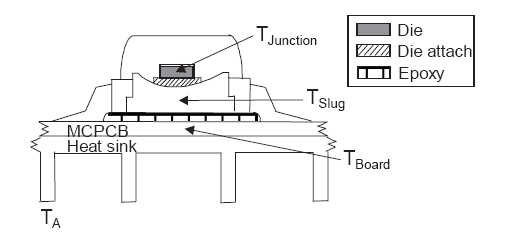
To understand what 'TJ' must watch this little diagram:
TJ [Temperature Junction] is the temperature at the 'smart' component. It is of course the hottest temperature of the assembly and TA [Room Temperature], the area cooler. Between junction and ambient heat is dissipated through a sum of 'thermal resistance, in ° / W (degrees per watt).
An example is more explicit: the encapsulation of the chip in its casing gives a thermal resistance of about 10 ° / W, the postponement of the LEDs on the heatsink 4 ° / W, the sink with the ambient air 5 ° / W. In this example the overall thermal resistance is 19 ° / W, which makes for an Electric Watt the chip will rise above the ambient of 19 °. For a temperature of 45 ° of ambient air around the LED and 3.5 watts power the chip temperature will be close to 111 °! Thus the power of 3.5 Watts, which may seem low at first, is important for a small radiating surface. In the absence of a sink with low thermal resistance, the temperature may destroy the component or cause significant loss of life.

It is important to maintain junction temperature as low as possible to ensure optimal operation. It should be noted here that the manufacturer's performance are data for a temperature of 25 ° C TJ that can never be applied in reality. It is a way for the manufacturer to submit its best features. A temperature of 80 TJ 100 ° C is closer to actual cases of use. It is therefore underestimate the nominal performance, very optimistic, which is specified for a TJ of 25 ° C.

The internal temperature of the LED will not only affect the quality of lighting, but also and especially on its aging. With the temperature performance degrades and the risk of failure increases. Thus we must maintain the TJ less than 85 ° C. It is advisable by the manufacturer to provide a distance of 1 inch (2.54 cm) between each LED and, of course, to provide a heat sink suitable for use. Sinks are well chosen to present a RTH (thermal resistance) compatible with the total power of each LED. There should be room temperature about 50 ° to avoid surprises. The thermal resistance is calculated during the design by the judicious choice of assembly and then a very neat implementation. The effectiveness of outcome can be measured with a simple light meter. Just put in operation the light at full power by measuring the evolution of luminous flux with the gradual rise of the junction temperature (time required to reach the maximum temperature is a few minutes).

It is imperative to provide heat dissipation and extremely relevant to ensure effective operation corresponding to the lifetime announced. At the theoretical calculation of performance must take into account a reduction of 10% of builder features are given for TJ 25 ° C.

In contrast, the heat is conducted through the body of the heatsink and thermal effects LED lighting is minimal with the aquarium. Thermal radiation is on the side opposite that of the light emission. Elevated water temperature is so much lower with LED lighting with traditional solutions since HQI T5 or almost nil.

Slip
spectral differences for the entire spectrum of production are very low (about 10 nm or less). From the perspective of color, the LED light source is perfectly calibrated. White LEDs drift very slowly toward the blue by degradation of their phosphor layer which does not pose a real problem.

junction temperature of the LED is also on the wavelength of emission, however, this influence is extremely minimal. An elevation of 100 ° C TJ wavelength increases from 5 nm (light red shift). This means that the peak 'Royal Blue' will be centered on 460 nm and the 'Blue' of 475 nm. This effect is not particularly significant but encourages the use of the 'Royal Blue' in Further LED 'cool white'.

update of an article previously written for the online magazine in August 2006 nanoZine

Back to homepage

Epson Cx4400 Ssc Service Utility

Contact Form

Nj Salvage Motorcycles

Solar radiation and photosynthesis

Solar radiation is a term used to describe visible light and near-visible, the latter composed by the ultraviolet and near infrared radiation from the sun. The components of solar radiation and Earth are classified by their wavelength within the band of 200 to 100,000 nm (nanometers): ULTRA VIOLET
  • 250 to 400 nm VISIBLE
  • 400 to 700 nm
  • NEAR INFRARED 700 to 3000 nm
Above the atmosphere, solar radiation has an intensity of 1370 watts per square meter. This is an average value designated as the solar constant . On the surface of the earth at noon, the direct radiation is about 1 kW per square meter. This average value depends on the location, season and time of day, but cloud cover (weather) that affects the energy received and the fact vary according to complex parameters.

The human eye perceives this radiation depending on its wavelength. We have a peak sensitivity in the yellow-green region, centered around 550 nanometers. Is a color that actually makes very visible signs and objects. Plant photosynthesis operates a broad spectrum including lengths red and blue wavelengths. The 'peak' of absorption, or optimum values are 630 nanometers for red and blue 450 nm. Graphs placed below show the response curves of comparative perception of the eye and efficiency of photosynthesis in plants. To complete this discussion, we must add that in the case of marine organisms, penetration of the wavelengths located in the red is rapidly attenuated by the natural water filter, so that this radiation is particularly useful for the growth terrestrial species. Blue is, however, a wavelength that is effective even at high depth. Lamps for horticultural land plants favor blue and red peaks, a lamp dedicated to marine photosynthetic organisms will favor the blue peak.
Lights are characterized by their color temperature in Kelvin. This sets the tone of a lamp, from cold to hot. The higher the color temperature increases over the perceived color appears blue, for a range that goes from red to purple / blue and white through. The marine environment and use of lighting color temperatures between 6500 high (cool white or daylight) and 20 000 Kelvin (deep blue). The lamps are also characterized by the Color Rendering Index (CRI) which indicates their ability to reproduce all the colors of the spectrum. But this interest is less in the aquarium to the extent we do not seek a neutral color but rather to enhance or exploit specific radiation.


spectrum sensitivity of photosynthesis compared to that of the human eye

The measurement of light is essentially adapted to human vision. It is based on how the light source is perceived and how our eye perceives light. We are particularly sensitive to yellow light and our measuring devices promote this region of the spectrum. The blue and red radiation effective for the plants are comparatively less represented. The sensitivity of the eye is the basis for a measure of luminous flux in lumens of illumination in lux (lumen / m²) and light intensity in candela (lumen / angle). These various units are actually related to each other. 100 lux lighting lumens means that 100 are received on one square meter of surface. But this system of measurement refers specifically to human vision and not about how plants can use light, which is our concern here. Another risk of misinterpretation, the sensitivity curve of the eye is not linear but logarithmic so that the qualitative assessment of light is easily mistaken without a meter. And very low light seems sufficient or strong light may be doubled without receiving a significant change. Judgement 'firsthand is therefore unreliable in terms of efficiency for photosynthesis.

A few technical
Plant growth is directly dependent on energy from sunlight. Photosynthesis (photochemistry) begins when a photon excites an electron (Stark-Einstein law). In 1972 Keith Mc Cree has demonstrated that counting photons of light radiation, predicted photosynthesis with greater precision than with a light meter. Scientists and industrialists in connection with the plants are naturally passed to this new measurement system called the lumen, Photosynthetic Photon Flux (PPF) and illumination Photon Flux Density Photosynthetical (PPFD). The energy of a photon is a quantum so that the apparatus for measuring the photosynthetic activity are also called quantum meters. The measure of light energy for plants is called Photosynthetic Active Radiation (PAR). The reaction of a plant with a PAR eventually leads to a result expressed in Photosynthetical Usable Radiation (PUR).

lamps for domestic use and can make a lot of lumens, allowing good illumination for our comfort, and still have a result on the plants well below the light sources that are developed specifically for this purpose. In our case (reef tanks), it is much more important to measure the PAR efficiency standpoint photosynthesis, ramps lighting aquariums while manufacturers or lovers generally do not communicate as the illumination in lux or lumens.

Ramps LED light Alpheus are designed with this in mind to provide the best solutions for optimal growth of animals, plants or marine aquarium freshwater adding control energy costs.

The reader interested in this subject will find the answers to her questions by consulting the excellent work by Stephane Fournier lighting aquariums Animalia Editions.

Back to homepage

How Do I Licence A Trailer

Shop LED lighting


Standard Range
Ramps LED light Alpheus are modular. The elements are based on extruded aluminum heatsinks with black finish sulfuric anodizing. They are machined to accommodate the LED circuit and secondary optics. The modules are arranged 'head to tail' with an axis between about 10 cm for a uniform distribution of illumination on the surface of the aquarium. All modules is maintained by an anodized aluminum frame. The thickness of a ramp is only 50mm high optical range, width and length are perfect fit for the aquarium. The ramp is suspended between 20 and 50 cm above the water surface.
Each module is equipped with a 700mA current regulation required for operation. This ensures a constant power of 2.5 watts emitted by each LED (200 lumens / LED). An external power supply between 24 and 28 volts DC is required as input to the current regulation. This voltage source is said to be SELV 'for Very Low Voltage Safety, actually it has a safe operation. The power consumed by each module is indicated in the specifications below. If several modules are grouped in a single ramp, food must accept the cumulative burden of all modules with a safety margin of 30%. Alpheus offers industrial power compatible with its products.
In case of failure of an LED for example, the faulty module is easily removed from the ramp (4 screws and connector) which allows it to return postal reclamation plant. The ramp continues to work with the remaining modules, each being independent. To maintain the high reliability of LEDs, in addition to a operation in the criteria builder, each circuit is drip (varnished for protection against corrosion). The modules are guaranteed for 3 years. According
models, current control circuit modules have two or three entries gradation (compatible PWM and linear from 0.5 to 2.5 volts). Each channel corresponds to a temperature of color: blue, white or mixed which allows a mix between 7500 and 20000K for reef applications. For the moonlight or the switching on and off gradually. Alpheus offers an automated self-control developed specifically for the management of reef aquarium lighting (solar cycles, lunar, seasonal, weather). Customizing settings is via an application on PC / Windows settings which communicates to the PLC by a Bluetooth wireless link (Bluetooth USB key for PC is included). Reloading the firmware of the controller, when changing it, use the same mode of communication. A web server maintains software versions which makes the system flexible and scalable. The management function controller can be added after the commissioning.
Summary of standard modules Alpheus

Ref. Length Optics White LED Blue PWM Power PUTTC
9M1006 200 mm 2 6 3 3 1 15 W 110 euros
9M1003 360 mm 4 12 6 6 2 30 W 185 euros
9M1002 495 mm 4 12 6 6 2 30 W 195 euros
9M1005 650 mm 6 18 9 9 3 45 W 255 euros
9M1001 780 mm 6 9 18 9 3 45 W 265 euros
9M1004 900 mm 7 21 11 10 3 52 W 320 euros

Other sizes / compositions contact us
Tariff LED modules
The standard module is 65 mm wide
Its height is 42mm with 15mm optical part. Two threads
M4 are arranged at each end with a pitch of 54mm and a distance from the edge of the sink 7mm.
These fasteners used to assemble the modules on the ramp.
Module Reference 9M1006
Mechanical L = 200mm, l = 65mm, h = 42mm, weight = 350 g (excluding frame and suspension system)
Optical Characteristics
3 CREE LED XR-E cool white 6500K group R2 200 lumens typical bin 00E01
3 LED CREE XR-E Royal Blue Group 16 λ = 450nm bin 00B01 900 mW
secondary focusing optics
Electrical Power 24 to 28 volts DC Power 15 Watts , 1200 lumens, (24Volts, 0.7 Amps)
Plan available, click here
Price: 110 euros TTC
Module Reference 9M1003
Mechanical L = 360mm , l = 65mm, h = 42mm, weight = 600 g (excluding frame and suspension system)
Optical Characteristics
6 LED CREE XR-E cool white 6500K group R2 200 lumens typical bin 00E01
6 LED CREE XR-E Royal Blue Group 16 λ = 450nm bin 00B01 900 mW
secondary focusing optics
Electrical Power 24 to 28 volts DC Power 30 Watts, 2400 lumens, (24Volts, 1.4 Amps)
Plan available, click here
Price: 185 euros TTC
Module Reference 9M1002
Features Mechanical L = 495mm, l = 65mm, h = 42mm, weight = 800 g (excluding frame and suspension system)
Optical characteristics
6 LED CREE XR-E cool white 6500K group R2 200 lumens typical bin 00E01
6 LED CREE XR-E Royal Blue Group 16 λ = 450nm bin 00B01 900 mW
secondary focusing optics
Electrical Supply 24 - 28 volts DC Power 30 Watts, 2400 lumens, (24Volts, 1.4 Amps)
Plan available, click here
Price: 195 euros TTC
Module Reference 9M1005
Mechanical L = 650mm, l = 65mm, h = 42mm, weight = 1100 g (without framing system and suspension)
Optical Characteristics
9 LED CREE XR-E cool white 6500K group R2 200 lumens typical bin 00E01
9 LED CREE XR-E Royal Blue Group 16 λ = 450nm bin 00B01 900 mW
secondary focusing optics
Features Electric Power 24 to 28 volts DC Power 45 Watts, 3600 lumens, (24Volts, 2.1 amps), 3 PWM
Plan available, click here
Price: 255 euros TTC
Module Reference 9M1001
Mechanical L = 780mm, l = 65mm, h = 42mm, weight = 1250 g (excluding frame and suspension system)
Optical Characteristics
9 LED CREE XR-E cool white 6500K group R2 200 lumens typical bin 00E01
9 LED CREE XR-E Royal Blue Group 16 λ = 450nm bin 00B01 900 mW
secondary optical focusing
Electrical Power 24 to 28 volts DC Power 45 Watts, 3600 lumens (24Volts, 2.1 amps), 3 PWM
Plan available, click here
Price: 265 euros TTC
Module Reference 9M1004
Mechanical L = 900mm, l = 65mm, h = 42mm, weight = 1450 g (excluding frame and suspension system)
Optical Characteristics
11 LED CREE XR-E cool white 6500K group R2 200 lumens typical bin 00E01
10 LED CREE XR-E blue Royal Group 16 λ = 450nm bin 00B01 900 mW
secondary focusing optics
Electrical Power 25 to 28 volts DC Power 52 Watts, 4200 lumens (24 Volts, 2.1 Amps), 3 PWM
Plan available, click here
Price: 315 euros TTC
Modules consist of a standard ratio 50% Cool White 7500K and 50% Royal Blue 450 nm, however other combinations are available upon request.
For example, the modules can be equipped with 100% royal blue (excellent complement to one or plasma Luxim HQI).
We see .
Booking form? Click here
depending on stock availability please contact us


Sample composition for a reef tank of 250 liters to 300 liters (# 900 x 600 x 500) :
Ramp 800 x 400 mm with 4 modules 9M1001 or 72 LEDs (175 Watts, 14000 lumens) at a cost of purchase from 1200 to 1500 euros depending on finish.
This ramp is more than 8 T5 39Watts (240 Watts). The initial purchase of T5 is smaller, between 450 and 900s euro for equipment with good reflectors. The ramp T5 requires an annual change of annual tubes, or 144 euros / year (based on 18 euro / tube). LEDs are also saving electricity: 36 euros / year (based on 1 kW / day). And amortization of original purchase is done between 3 and 5 years.
New: Range Mini modules
These modules are available in two models: The first
has 4 LED 2.5 Watts (real) and one section measuring 250mm 30x30mm
The module produces 800 lumens 10 watts so its length is 25cm are price is 49 euros
Kit 3 modules (30 Watts real) + the 24V is proposed at 195 euros. This package is a nano about 30 liters.

full description of each module 10W:
  • 2 LED CREE XR-E Cool White 7500 Kelvin degree Q5/R2 driven at 700 mA (80 lumens / Watt)
  • 2 LED CREE XR-E Royal Blue 450 nm group 16 (80 lumens Watt equivalent)
  • Protection PMMA cast high optical quality
  • Heatsink sized to avoid using a fan to 45 ° ambient.
for kits 3 or 4 modules there is the possibility of a separate control of blue and white LEDs. They are compatible with automatic dimming.

The second module is twice the first, 20 Watts 1600 lumens a length of 50 cm. Its price is 95 euros. It is possible to assemble the 'butt' to make a module of 1 m length, 40 watts (equivalent to a 80W T5).

The modules can be equipped with any combination of blue and white LEDs on request, for example 100% royal blue to complement HQI.

Tariff power

Each module has a current regulation but one or more power supplies 24 volts are needed to operate the ramp. Power is calculated by summing the powers of each module and providing a safety margin of at least 20%.


Questions? Other models we refer


Tariff PLC management

The controller has three channels of dimming PWM 16-bit (32,640 levels or steps of 0.003%). This allows very precise control and programming light intensity according to the daily cycle and possibly annual. The fineness of not allowing a true lunar lighting compatible with the physiology of reef animals. The updated firmware and the settings are from a Windows PC with a Bluetooth communication. The price of the controller includes: the electronic card, software licenses (controller firmware and PC application) a key and a Bluetooth PC CD-ROM which also contains the user manual. The automatic feed between 5 and 28 volts (the power LED of the ramp should be fine). It thus enables the independent management of solar cycles, lunar, and seasonal weather. The controller can also be placed under the control of the PC that allows perfect synchronization of several ramps. All software updates (Windows PC application and the controller firmware) are free thereby benefit from innovations developed for the wellbeing of your residents. Price 238 Euro
TTC.

Booking form? Click here
Questions? Availability? contact us

Map Alpheus 10C1001 with Bluetooth

Screenshots PC software


handyman's Corner

Alpheus not forget handymen and helps them realize their own ramps LEDs. Here is a list of elements for mounting 'DIY':

References Price List
LED CREE XR-E white wire or PCB paste on heat sink (bare emitter)
Reference XREWHT-R2 (00E01 Binning 114 lumens @ 350mA min chroma available WM 7000-8000 K)
6.50 euros
Lot of 50 LED CREE XR-E white wire to PCB or stick on heat sink (bare emitter)
Reference XREWHT-R2 (00E01 Binning 114 lumens @ 350mA min chroma available WM 7000-8000 K)
300 euros
LED CREE XR-E blue wire or stick on PCB sink (bare emitter)
Reference XREROY-16 (500mW min binning 00B01 @ 350mA chroma D3 450 nm)
6.50 euros
Set of 50 LED CREE XR-E blue wire to PCB or stick on heat sink (bare emitter)
Reference XREROY-16 (binning 00B01 500 mW @ 350 mA min chroma D3 450 nm)
300 euros
positioning for bare PCB 3 LED CREE XR-E and an optical reference 9C1001 4 euros
Circuit with 3 LEDs CREE XR-E for adhesive bonding
heat-sink on
2 white 1 blue Reference 9C1001-1 white EQ1
Reference 9C1001-2 blue 3 blue
EQ2 Reference 9C1001-EQ3
Note: The circuits are tested before shipment Returns are not accepted.
Caution: This circuit is absolutely LED mounted by gluing with an adhesive on a heatsink thermally properly sized. In case of default installation there is a risk of overheating and rapid deterioration of SLE.
25 euros
Optics for 3 LED CREE XR-E 9011 Reference 4 euros
Heatsink 200mm machined reference 9M1006-NC 20 euros
Heatsink 360mm machined reference 9M1003-NC 25 euros
Heatsink 495mm machined reference 9M1002-NC 30 euros
Heatsink 650mm machined reference 9M1005-NC 40 euros
Heatsink 780mm machined reference 9M1001-NC 45 euros
Heatsink 900mm machined reference 9M1004-NC 55 euros
control circuit 2 channel dimmable 700mA 9C1002-2 18 euros
control circuit 3 channel dimmable 700mA 9C1002-3 22 euros
10C1001 Automatic dimming PWM channels 3 9C1004-3 (maximum number of control boards connected to the PLC 20). ATMEL 16 MHz processor 256k prog settings using Bluetooth connectivity, backup cycles by 10 days supercap Supply 12 to 36 volts. 238 euros
thermally adhesive glue Loctite 315 + AS-activator (bonding capacity of 600 + LED) 72 euros
thermally adhesive glue Electrolube Two-component TBS20S 32 euros
acrylic conformal coatings Electrolube APL 15 ml 9.50 euros
supply 24 Volts 50 Watts 25 euros
supply 24 Volts 75 Watts 30 euros
supply 24 Volts 150 Watts (adjustable fanless) 50 euros
Power 27 Volts 200 Watts (adjustable fan) 60 euros
module interconnection cord (a cord by providing Module - power cords) 10 euros
Cord DC 24 Volt - module (provide a power cord through) 25 euros

Price per unit shipping the rates in force. Amount exceeding 5 parts contact us .

Booking form? Click here
Warning: The prices and availability are subject to current inventory and may be re-evaluated, contact us for confirmation before ordering.