In our reef aquariums, LEDs (Light Emitting Diode), or the French 'DEL' (Light Emitting Diode), are they a credible alternative to conventional solutions based on the T5 fluorescent tubes and lamps HQI? Here are some answers.
 power type LED CREE XR-E
 The new generation of power LEDs meet the needs of the signaling car or public, domestic lighting, from backlight screens LCD, camera flashes, etc.. This market is driven by new technologies and the need to reduce energy costs for lighting systems. The desire to make them more 'green' by prohibiting the use of toxic compounds to the environment wins too slowly on the ground.
The advantages put forward by the manufacturers of LEDs are:
The advantages put forward by the manufacturers of LEDs are:
- a very good reliability (degradation does not exceed 70% of initial performance with less than 5% down after 50,000 hours of use (10 years). This life is very much superior to other solutions applicable Market aquarist)
- a compact miniature
- low voltage (electrical safety),
- no inertia when switching on or off (the response time of few nanoseconds allows graduation cutting the ignition timing or PWM),
- respect for the environment (the LED must comply with new requirements RoHS [Restriction of certain Hazardous Substances] applicable in the EEC),
- a good choice of colors,
- yield equivalent and often superior to that of conventional lamps (incandescent, halogen, fluorescent, metal halide, etc.).. LEDs for power, meanwhile, have one of the best power conversion efficiency - light intensity.
Aquarists there are other points of interest, particularly for reef aquariums:
- light spectrum LED in cool white (or 'cool white') is at a temperature of 6500 Kelvin. This color temperature is consistent with the need reef and photosynthetic activity. FC Solar radiation and photosynthesis . The LED 'cool white' are the easiest to produce because they require less intake of phosphorus than the LEDs 'white hot', ideal for domestic lighting, they are a bit cheaper and have better performance especially.
- the blue and royal blue LEDs advantageously replace the tubes and super actinic actinic and do not emit UV. The wavelength is always characteristic of a type of LED, for example 455 nm for the 'Royal Blue') and it is perfect for aquarium use because effective for photosynthesis.
- light intensity available is currently about 100 to 140 lumens per watt LED, which is excellent and an LED can operate a power of 3 Watts. It is now possible to achieve ramps consist exclusively of LED lighting. The number is simply calculated to correspond perfectly to the volume and need.
- thermal radiation in the direction of the tank is minimal or nonexistent.
The feasibility of a 'spot LED', specifically designed for reef aquarium, is indeed possible. But before buying a spot it is best to understand "how it works' points of detail that makes the difference, because all the LED systems are not equivalent, and whether the expected performance are consistent with the need .
Features LED power
This article takes the example of the LED CREE XR-E XLAMP, the equivalent power LED: Luxeon Rebel, Seoul P4, Edison, Samsung, Nichia, Osram, etc.. could also be used for this demonstration. These LED power of 3 to 5 Watts whose yield is between 100 and 140 lumens / Watt and should not be confused with the conventional LED (without sole sink) and whose performance is lower.
You can find the complete documentation of the LED XR-E site CREE ® ™ XLAMP .
The graph below (source: Lumileds Luxeon) indicates that the performance of LEDs are improving generation after generation. Hopefully prices currently very high, will fall when the LEDs will be widely used for lighting. However, there is no certainty because the technology can change very significantly.
 The principle of implementation
intensity produced by an LED CREE XR-E R2 group is about 120 lumens. This is modest when compared to 9000 lumens with a 150W HQI lamp. But this intensity is obtained by passing a current of 350 mA, or about 1 watt of electrical power in an LED. The yield of lumens / Watt LED is better than the HQI (60 lumens / Watt).
Supply current of LED can be increased up to 1000 mA. The yield curve tends to bend, however, meaning that the light output at 700 mA is less than twice that at 350 mA (175%). We see that the current also has the disadvantage of heating the LED and in practice the maximum current of 1000mA that is rarely exploited. Alpheus uses a supply current of 700 mA to optimize the ratio of light intensity / cost. The LEDs used are CREE XR-E R2 groups for white 6500 K, which provides 200 lumens typical LED under 700 mA, and 16 for the blue group Royal. These are the most efficient LED range CREE XR-E.
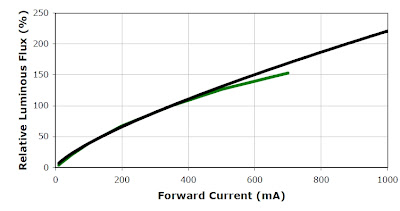 curve of light output depending on the intensity
All diodes are characterized by a voltage that corresponds to the voltage threshold from which the diode becomes conductive. This voltage is usually denoted VF [Forward Voltage] , it characterizes all the diodes and thus the LEDs.
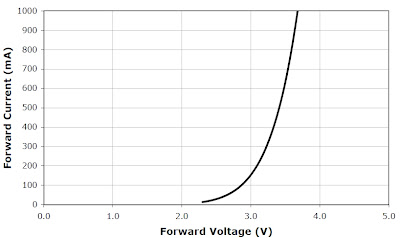 The curve indicates a voltage of 3.3 volts when forward current IF is 350 mA and 3.7 V at 1A. That means a minimum voltage of 3.5 volts for an LED CREE XR-E work. This also means that the diode will dissipate a power equal to the formula P = IU, or about 3.5 times the current value. This supports a range of diode current of about 1A and are classified for Watts '3 '.
Currently the best power LEDs emit a light intensity greater than 120 lumens per watt . This result is good, this terrain LEDs exceed T5 and HQI are at par with the best fluorescent lamps and high efficiency sulfur plasma lamps.
Features bright
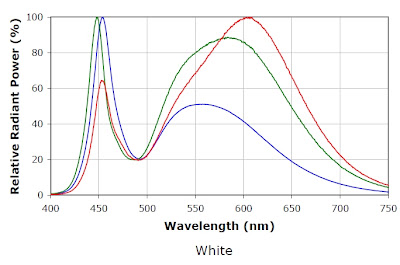 The spectrum of the white LED 'cool white', the blue curve of the diagram, is given to 6500K. In reality the emission is composed of two peaks:
Features LED power
This article takes the example of the LED CREE XR-E XLAMP, the equivalent power LED: Luxeon Rebel, Seoul P4, Edison, Samsung, Nichia, Osram, etc.. could also be used for this demonstration. These LED power of 3 to 5 Watts whose yield is between 100 and 140 lumens / Watt and should not be confused with the conventional LED (without sole sink) and whose performance is lower.
You can find the complete documentation of the LED XR-E site CREE ® ™ XLAMP .
The graph below (source: Lumileds Luxeon) indicates that the performance of LEDs are improving generation after generation. Hopefully prices currently very high, will fall when the LEDs will be widely used for lighting. However, there is no certainty because the technology can change very significantly.
 The principle of implementation
 intensity produced by an LED CREE XR-E R2 group is about 120 lumens. This is modest when compared to 9000 lumens with a 150W HQI lamp. But this intensity is obtained by passing a current of 350 mA, or about 1 watt of electrical power in an LED. The yield of lumens / Watt LED is better than the HQI (60 lumens / Watt).
Supply current of LED can be increased up to 1000 mA. The yield curve tends to bend, however, meaning that the light output at 700 mA is less than twice that at 350 mA (175%). We see that the current also has the disadvantage of heating the LED and in practice the maximum current of 1000mA that is rarely exploited. Alpheus uses a supply current of 700 mA to optimize the ratio of light intensity / cost. The LEDs used are CREE XR-E R2 groups for white 6500 K, which provides 200 lumens typical LED under 700 mA, and 16 for the blue group Royal. These are the most efficient LED range CREE XR-E.
 curve of light output depending on the intensity
 All diodes are characterized by a voltage that corresponds to the voltage threshold from which the diode becomes conductive. This voltage is usually denoted VF [Forward Voltage] , it characterizes all the diodes and thus the LEDs.
 The curve indicates a voltage of 3.3 volts when forward current IF is 350 mA and 3.7 V at 1A. That means a minimum voltage of 3.5 volts for an LED CREE XR-E work. This also means that the diode will dissipate a power equal to the formula P = IU, or about 3.5 times the current value. This supports a range of diode current of about 1A and are classified for Watts '3 '.
 Currently the best power LEDs emit a light intensity greater than 120 lumens per watt . This result is good, this terrain LEDs exceed T5 and HQI are at par with the best fluorescent lamps and high efficiency sulfur plasma lamps.
Features bright
 The spectrum of the white LED 'cool white', the blue curve of the diagram, is given to 6500K. In reality the emission is composed of two peaks:
 - the first is close enough to 455 nm (blue - purple)
- the second largest is 550 nm (green - orange)
The value of 6500K is a rendering method that does not really characterize the spectrum. Here blue is favored with a wavelength very interesting for our reefs. This wavelength naturally favors the growth of zooxanthellae invertebrates. The second peak gives addition color rendering final 'white' and natural light. It also promotes photosynthesis and allows the observation of different colors of marine organisms by improving the CRI (Colour Rendering Index). Note that this spectrum is more complete than most of those obtained with metal halide lamps. On the other hand it is perfectly controlled and characterized.
 In the rest of the line XR-E two other references we are particularly interested: The 'Royal Blue' which corresponds to the peak at 455 nm of the white LED, (whose manufacture is actually based on this model), and the 'Blue' with a wavelength of 470 nm.
 To promote the wavelength of 450 nm, which reproduces a deep-seated position, it is customary to add blue tubes 'supra actinic' facilities HQI. Further that this temperature has an undeniable aesthetic appeal, this reinforces the useful spectrum for photosynthesis and provides light transitions. Blue light excites the low natural fluorescence of some corals and allows its observation. LED lighting generally uses the colors 'blue' or 'royal blue' in addition to enhancing the color temperature of white LEDs, cool white.'' The color temperature obtained by this combination varies from 6500 to 20000 Kelvin function of the ratio white / blue and setting 'dimming' of the two channels.
LEDs are calibrated spectrum that differs very little from the nominal specifications. LED (white or blue) do not produce UV. This has the advantage not to risk exposing organisms to radiation and too hard to overcome a filter reducing the light flux which is necessary with 20,000 K HQI The power LED are in accordance with IEC 825 safety on emission of light sources. Intensity point however is that it is better not to try watch them directly without protection.
The table below is specific to each manufacturer. It indicates the luminous intensity of LEDs and their color according to a further sorting called 'binning'. The 'binning' is an important checkpoint to select LEDs according to their performance and chromaticism. This is a specialist business and Alpheus selects the best components for use reef. Also note that a white LED to yield 'lumens' four times while a blue LED useful energy for photosynthesis is almost identical. FC Solar radiation and photosynthesis .  In the rest of the line XR-E two other references we are particularly interested: The 'Royal Blue' which corresponds to the peak at 455 nm of the white LED, (whose manufacture is actually based on this model), and the 'Blue' with a wavelength of 470 nm.
  To promote the wavelength of 450 nm, which reproduces a deep-seated position, it is customary to add blue tubes 'supra actinic' facilities HQI. Further that this temperature has an undeniable aesthetic appeal, this reinforces the useful spectrum for photosynthesis and provides light transitions. Blue light excites the low natural fluorescence of some corals and allows its observation. LED lighting generally uses the colors 'blue' or 'royal blue' in addition to enhancing the color temperature of white LEDs, cool white.'' The color temperature obtained by this combination varies from 6500 to 20000 Kelvin function of the ratio white / blue and setting 'dimming' of the two channels.
 LEDs are calibrated spectrum that differs very little from the nominal specifications. LED (white or blue) do not produce UV. This has the advantage not to risk exposing organisms to radiation and too hard to overcome a filter reducing the light flux which is necessary with 20,000 K HQI The power LED are in accordance with IEC 825 safety on emission of light sources. Intensity point however is that it is better not to try watch them directly without protection.


 Summary wavelengths min / max LED CREE and flow according to the 'binning'
 The spectral features are thus identical or above the HQI lamps with only a few compounds spectra of narrow lines. The result is comparable to T5 when additional tubes are combined within a single ramp, taking care to analyze the spectrum of each tube. In Indeed the information is rarely sufficient and lack of action with a PAR meter looks not sufficient to judge the quality of lighting. The problem of the choice of metal halide lamps and T5 arises repeatedly in each bulb replacement LED technology while with the original properties are retained for many years without adverse changes in the animal environment zooxanthellae.
Should add red LEDs to promote photosynthesis? Certainly for terrestrial plants and aquarium plants freshwater developing near the surface. This is less obvious in the case of marine organisms. The penetration of red radiation is strongly attenuated with the water layer and does longer a vital need beyond a few meters. FC LEDs light the Eco-friendly ' . For biotopes located very close to the surface or fresh water it is interesting to reduce the temperature by adding color LED 'natural white' or even 'warm white' white hotter.
The white LED 'cool white' has a spectrum compatible with reef use. LEDs 'blue' or 'royal blue' are added to accentuate the color temperature blue and lengthen the duration of the observation phase without further adding to the photoperiod. Alpheus chose a ratio of 50% of white 6500K for 50% of royal blue. The result lighting is from 14000 to 20000 Kelvin depending on rating. LEDs 'warm white' and 'red' are usually reserved for freshwater aquariums.
LEDs, a 'spot' natural
The achievement of good specular aluminum reflector with capital or HQI T5 technology and this task is not simple. With LED technology, it is quite otherwise.
 This curve shows the opening angle of the light output of LEDs. The light is focused while a traditional lamp emits in all directions. Since in this case, the objective is to obtain a directed light only to the aquarium, this technology is significantly superior to traditional solutions that require reflectors. Focusing lenses also allow additional concentration of luminous flux. The ramp can be mounted above the tank with low losses. The walls of the tank are less enlightened thereby reducing the growth of undesirable algae, increases the contrast between the aquarium and its environment and enhances the effects of perspectives.
  The mixture of colors is also optimized by special lenses to focus and diffusion. These are lenses that have been selected by Alpheus.
 LEDs have the advantage of directing and focusing the light flow naturally. This effect can 'recover' the lumens lost by fluorescent or metal halide lamps that scatter the light emission despite the use of reflectors. The resulting light output of LEDs is increased by 30% to 50% and this contributes to the excellent result of LED lighting.
Implementation and thermal problem
The 'derating' reflects the misbehavior of any element relative to design specifications established by the manufacturer. Two types difference is essential to take into consideration:
1. Dispersions voltages VF
 Voltage fluctuations VF compared to the nominal value are quite significant.
 Another point to consider, the builder reported a variation of 0.5 Volt VF during the first hours of operation. This means putting in place an independent means of changes in VF to limit the current flowing through the LED. Specifically the single resistor in series with an LED low power is not enough.
LEDs imperatively require a specific diet controlled current.
2. Dispersions due to temperature
Other differences relate to a 'derating' overall characteristics as a function of temperature.
 The manufacturer's performance data are for a temperature TJ [Junction Temperature] 25 ° C. Performance is reduced by 20% for a temperature of 110 ° C. TJ (The LED is destroyed with a temperature greater than TJ 160 ° C).
 To understand what 'TJ' must watch this little diagram:

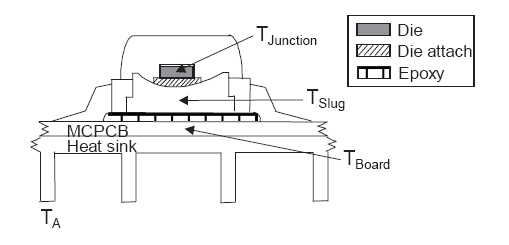
An example is more explicit: the encapsulation of the chip in its casing gives a thermal resistance of about 10 ° / W, the postponement of the LEDs on the heatsink 4 ° / W, the sink with the ambient air 5 ° / W. In this example the overall thermal resistance is 19 ° / W, which makes for an Electric Watt the chip will rise above the ambient of 19 °. For a temperature of 45 ° of ambient air around the LED and 3.5 watts power the chip temperature will be close to 111 °! Thus the power of 3.5 Watts, which may seem low at first, is important for a small radiating surface. In the absence of a sink with low thermal resistance, the temperature may destroy the component or cause significant loss of life.
It is important to maintain junction temperature as low as possible to ensure optimal operation. It should be noted here that the manufacturer's performance are data for a temperature of 25 ° C TJ that can never be applied in reality. It is a way for the manufacturer to submit its best features. A temperature of 80 TJ 100 ° C is closer to actual cases of use. It is therefore underestimate the nominal performance, very optimistic, which is specified for a TJ of 25 ° C.
The internal temperature of the LED will not only affect the quality of lighting, but also and especially on its aging. With the temperature performance degrades and the risk of failure increases. Thus we must maintain the TJ less than 85 ° C. It is advisable by the manufacturer to provide a distance of 1 inch (2.54 cm) between each LED and, of course, to provide a heat sink suitable for use. Sinks are well chosen to present a RTH (thermal resistance) compatible with the total power of each LED.
 There should be room temperature about 50 ° to avoid surprises. The thermal resistance is calculated during the design by the judicious choice of assembly and then a very neat implementation. The effectiveness of outcome can be measured with a simple light meter. Just put in operation the light at full power by measuring the evolution of luminous flux with the gradual rise of the junction temperature (time required to reach the maximum temperature is a few minutes).
 It is imperative to provide heat dissipation and extremely relevant to ensure effective operation corresponding to the lifetime announced. At the theoretical calculation of performance must take into account a reduction of 10% of builder features are given for TJ 25 ° C.
 In contrast, the heat is conducted through the body of the heatsink and thermal effects LED lighting is minimal with the aquarium. Thermal radiation is on the side opposite that of the light emission. Elevated water temperature is so much lower with LED lighting with traditional solutions since HQI T5 or almost nil.
 Slip
spectral differences for the entire spectrum of production are very low (about 10 nm or less). From the perspective of color, the LED light source is perfectly calibrated. White LEDs drift very slowly toward the blue by degradation of their phosphor layer which does not pose a real problem.
junction temperature of the LED is also on the wavelength of emission, however, this influence is extremely minimal. An elevation of 100 ° C TJ wavelength increases from 5 nm (light red shift). This means that the peak 'Royal Blue' will be centered on 460 nm and the 'Blue' of 475 nm. This effect is not particularly significant but encourages the use of the 'Royal Blue' in Further LED 'cool white'.
update of an article previously written for the online magazine in August 2006 nanoZine
Back to homepage


0 comments:
Post a Comment