Alpheus designs and develops LED lighting for aquariums with high performance.
The equipment offered for reef aquariums use secure technologies and energy saving. This respect for the environment is of course by that of animals placed in the aquarium. For this reason, the technical choices are made above all other considerations, to obtain the best results to ensure the conservation and propagation of species dependent on photosynthesis. Tests conducted since 2006 on our reef systems to verify by experiment the validity of our options.
Personal safety, dependability, availability of equipment and also the visual amenity are not overlooked and are important points of this approach.
Personalized service
Because each aquarium is unique, Alpheus develops a range of facilities perfectly adapted to the dimensions of your aquarium. You define your exact needs, you may be guided by the contact form online. The specific requirements are considered and we validate a joint solution. So you have the satisfaction of achievement to measure consistent your goal. The components of the standard equipment, however, limiting manufacturing costs. Ask us to quote the price of these modular devices is equivalent to complete the proposed ramps in series. This design adds other benefits compared to a ramp monolithic, as, for example, removing a module for an overhaul while maintaining the operational ramp or a reorganization to adapt to a new aquarium.
Products can be delivered at various stages of completion or kit, consisting of simple modules wired and tested ready to be embedded in a carrier. For the more skilled it is an economy and also a custom finish. In all cases, Alpheus, a specialist in reef aquariums, advises and supports you in choosing and maintaining your aquarium.
Direct access to the store
LED Lighting Direct access to the store Automation (under development, please contact us for quotation)
LEDs: a solution for lighting aquarium eco-friendly '
 The position as "an energy "Of the reef aquarium is undoubtedly the canopy. The light intensity must indeed satisfy the needs of photosynthetic organisms, including corals symbiotic algae zooxanthellae. To perform this vital function, illumination reproduces the natural environment of the tropics. This implies an illumination intensity in a high color temperature. One of the best conversion efficiencies of light, approximately 100 lumens per watt, is achieved through components LED (Light Emitting Diode) - or LED (acronym for Light Emitting Diode). It is therefore natural to make ramps based on this technology. We proceed to development since 2006 and test prototypes on our reef aquariums illuminated only by ramps with LEDs. The result of these tests demonstrate compatibility with the physiology of reef organisms. The energy gain obtained compared to traditional solutions is close to a ratio of two. This result is also a consequence of the high directionality of LEDs that greatly reduces the losses by scattering or reflection. The illumination is evenly distributed areas without too many or too few choices. Thus, an aquarium where a ramp 400 Watt HQI was necessary may be illuminated by LEDs with only 200 watts power. Energy useful light for photosynthesis will be equivalent. However this figure is not a constant of all LED lighting, the selection of components, their implementation must be done within the rules of art and with attention to an excellent result. See this topic headings: LED technology and Solar radiation and photosynthesis
 The choice of LED lighting should not be done on the simple observation of a favorable energy balance. Other criteria to consider to ensure that lighting is able to perform its function and give full satisfaction.
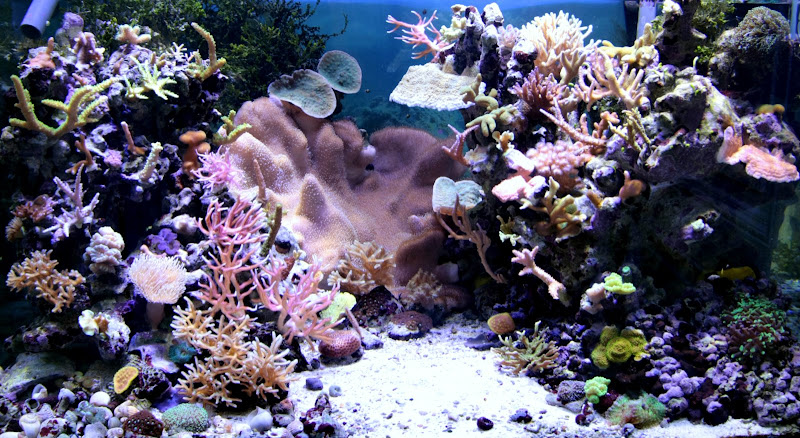 Aquarium Test lit solely by LEDs
 tracking the evolution of many cuttings SPS and Tridacna (giant clam)
Energy, light spectrum and photosynthesis
While the measure lumens is a good indication of the illumination seen by our vision, light energy for photosynthesis is preferably measured with a PAR meter. PAR stands for Photosynthetically Active Radiation. The PAR is the unit mol / m / s which corresponds to a radiometric energy. Indeed, vision and photosynthesis differ on matters it is interesting to know to properly understand the lighting of an aquarium.
An approach to determine the light intensity necessary for an aquarium is to replicate the quality and quantity of light energy received in one day in a natural environment and at a given depth. The energy received at the surface on a sunny day for a tropical area is 50mol / m². Note that most of the energy is supplied during the 6 hours that the sun is highest in the sky (we used this term of reference to determine the photoperiod useful). Reflection due mitigates the impact strongly inclined rays of dawn and dusk. In the aquarium this value should be lower because it takes into account the attenuation due to the depth of water corresponding middle reproduced and also lengthening the duration of the illumination of the aquarium to satisfy the viewer. Again, the LEDs are also an excellent solution to calibrate the color temperature, intensity and duration of illumination depending on the biotope and recreated on the requirements of the aquarium.


curve of intensity and chromatic reduction (Source Educnet) versus water depth
water filter solar radiation and solar spectrum is reduced quickly to initial wavelengths from green to UV-A long close to the visible. The colors red, hot, characteristics of dawn and dusk, are masked by the impact and reflection of rays, so too strongly inclined to enter the aquatic environment. The color temperatures are, for a marine aquarium in the range 20 000-10 000 K (Kelvin).
Regarding the photo-period, there is still respect the natural conditions, a bright light over a period relatively short, approximately 6 hours. Subdued lighting can be extended as actually present in the natural environment and also benefit from a longer observation period. The dimming is therefore a major asset. A series of photo-adaptation of animals and plants may also be necessary before the high energy delivered by the LED lighting Alpheus. The creation of 'breaks' during the phase of maximum illumination to optimize the cycle of photosynthesis and avoid the risk of photo-inhibition. These breaks can be made by the simulation of cloudy and are also naturally present through alternations to light due to surface movement.
addition biotope, population photosynthetic parameters affecting the irradiance as water clarity (turbidity) of the aquarium, the use of charcoal, possibly ozone enhances transparency, the presence a white background that reflects light, are quantitative and qualitative elements that must be integrated to define the ramp LED light ideal for your use reef.
In summary, according to the choice of the aquarium, it takes between 50 and 300 mol / m / s to maintain properly invertebrates symbiotic in aquariums. A color temperature of 14000K is an average basis which can be further increased.
Readers wishing to explore this subject refer to the work of Stéphane Fournier " lighting aquariums " published Animalia.
Dimming light
The possibility of a change in the intensity of lighting is an excellent solution for metering energy, respect and physiological cycles also bring an additional authorization in the contemplation of his aquarium. LED technology is "dimmable", which means it is possible to decrease or increase Gradually the light intensity. Alpheus with the ramps, LEDs of different color temperatures are independently Assayable not change too small (the encoding is 16 bits, or variations of 0.03%). For the aquarist is the visual amenity of sunrise and sunset, the possibility of adjusting its light very precisely according to its habitat and the opportunity to showcase the coral fluorescence visible under bright deep blue. For organizations of the aquarium, the reproduction of natural solar and lunar cycles provides significant physiological benefit. Solar time, the simulation of cloudy, colorimetry, all parameters are recreating the natural environment under the control of a controller built into the ramp. This is configured in the factory, it is also adjustable and controllable by the user using a PC with a Bluetooth connection. A program for Windows comes with the controller (and the key for PC Bluetooth communication). Menus provide access to parameters defining the different cycles, or switch to manual mode where control is direct. The controller also adds elements of comfort as the cumulative hours of operation of the ramp or the fan control air conditioning if intégré.Voir detail in Shop Lighting LED
In the case of replacing a traditional ramp by ramp Alpheus, the old ramp will be measured or assessed before its removal to determine its BY intensity. An automatic, specific ramps Alpheus, gradually increase this value to achieve the optimal flow while eliminating the risk of photo-inhibition. The animals are not stressed by an abrupt difference in light intensity.
Elevation reduced thermal
The LED illumination does not cause virtually no elevation heat which significantly reduces the need for an air conditioning during periods of heat. Avoid this system, which is particularly energy intensive, is good news for enthusiasts concerned about the future of the planet. An air conditioner based on mere fans help evaporate the water surface is usually sufficient with a LED bargraph. The fans can be integration into the ramp and steering from the automatic lighting control.
Quality Guarantee
Components LEDs have a lifetime of remarkable 50,000 hours, which corresponds not to a failure, but a reduction of 30% of initial lumens. This figure is however valid only if they meet the design rules imposed by the manufacturers of LEDs and a poorly designed ramp will not reach this time. Alpheus applies to reaching a long period of use without loss of performance and commitment over a three year warranty for all its products. Each ramp comes with a certificate stating the extent BY done after development, that is to say its optimum efficiency to serve as future reference. It is only those circumstances that the LED lamps make substantial savings compared repeated changes at best annually, tubes fluorescents or metal halide. It also means less waste to recycle. However, failures are possible and replacing faulty LED should not be an insoluble problem. But these components are not removable simpleùent. To overcome this drawback Alpheus ramps are designed modular. The modules are easily removable and can be repaired without disturbing the overall operation of the ramp.
For more information see: The LED technology has
Placement
Les rampes alpheus sont équipées de lentilles secondaires. Celles-ci sont indispensables car les LED de puissance ne focalisent pas la lumière (ouverture de 90 à 125° selon les modèles) et des pertes peuvent survenir. Les lentilles concentrent la lumière dans un cône utile de 10 à 40° selon les modèles. Ces lentilles regroupent trois LED et sont constituées de micro diffuseurs de sorte à ce que le mélange chromatique soit parfait (pas de distinction possible des zones bleues ou blanches). Grâce à l'utilisation de lentilles de focalisation, les rampes alpheus peuvent être suspendues jusqu'à 50 cm de la surface de l'eau ce qui minimise les pertes optiques. L'éloignement de The ramp also allows the light sources away from splashing water, the source of corrosion and fouling. Access to the aquarium from above remains free and the general appearance of more open and natural. Unlike fluorescent tubes, the effect of shimmering light on the sand and the scenery is very realistic. This natural effect is not just aesthetic, it also brings a benefit to animals zooxanthellae significantly enhancing the efficiency of photosynthesis.
 dimming light output by 4 meters in natural
 Safeties
LED lighting also has an advantage: risk reduction electrical, thermal and optical. The power circuit is made of LED, Low Voltage Safety '(SELV), that is to say a voltage below 30 VDC and isolated area. In this case a default installation does not present a risk of electrocution as is the case for a ramp driven at 220 volts. This is important for a facility located in humid and saline. On the other hand, the low operating temperature eliminates any risk of burns from accidental contact. The choice of generously sized heatsinks overcomes the fans source of failure and noise. Finally, the spectral stability eliminates ultraviolet radiation harmful to living cells.

Summary of key points of the ramps Alpheus
- A Tough choices of the best components available, the full mastery of the development and manufacturing. A
- adequacy verified with the needs of photosynthetic organisms reef aquariums.
- An adaptive modular design that allows, for example, repairing a simple mail without a complete cessation of the ramp.
- A heat dissipation by natural convection largely dimensioned to prevent the use of fans (silence and reliability).
- A comprehensive management controller and optional upgradeable to minimize the initial cost.
- An investment in height that allows unobstructed surface of the aquarium.
- warranted for three years and a permanent availability for the assurance of a return on investment.
Without omitting the benefits inherent in LED technology: Reduction of energy consumption, long lifespan, low heat release into the aquarium, all gradations possible, ...
A video of the aquarium in which the effect is visible light vibration
switchboards and automation
Alpheus protects the environment but is also concerned with people. Switchboards having differential protection, earth sensors and automation are offered.
As for lighting tracks, achievements are made on customer specifications for a perfect result adapted as needed.
For more information look under Automation.


0 comments:
Post a Comment